大会長挨拶 / Greetings
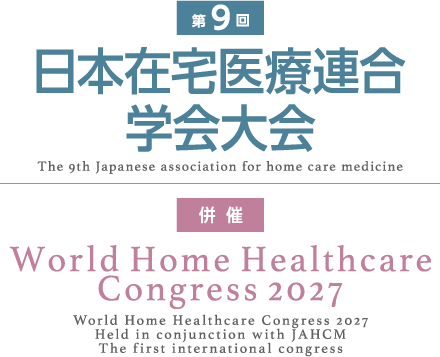
第9回日本在宅医療連合学会大会
併催 World Home Healthcare Congress 2027 (WHHC 2027)
大会長 佐々木 淳(医療法人社団悠翔会 理事長)
The 9th Annual Meeting of the Japanese Association for Home Care Medicine
World Home Healthcare Congress 2027 (WHHC 2027)
Jun Sasaki, Congress President(Chairman, Yushoukai Medical Corporation)
在宅療養支援診療所が制度化されてから20年が経過しました。
この間、在宅医療は質量両面で拡大し、一定の役割を果たしてきました。
しかしそれは社会のニーズに主体的に応えてきたというよりは、制度の枠組みに依存・適応してきたというのが実情だと思います。
そのようななか、2026年の診療報酬改定は、在宅医療の提供体制や価値の定義そのものに変化を迫っています。
いま私たちに問われているのは「制度の中で何ができるか」ではなく、「これからの社会に対して在宅医療は何を担うべきか」ではないでしょうか。
本大会は、その問いに正面から向き合います。
日本の在宅医療は、慢性期のプライマリケアがメインです。
本大会ではその対象領域を積極的に拡大し、在宅入院、移行期・回復期支援、地域緩和ケアと意思決定支援など、新しいカテゴリで再整理を試みます。
目指すべきは既存の枠組みを前提とした「改善」ではなく、社会の変化や技術革新を踏まえたケアの在り方そのものの再定義。未来のニーズをともに探るとともに、優れた実践例の共有の場としたいと思います。
また、今大会は国際大会を併催します。
これは日本在宅医療連合学会としては初の試みです。
超高齢化と制度の完成度で先行する日本の実践は、果たして「成功例」なのか。その構造的な限界や課題を含め、海外からの視点とともに検証します。
超高齢化は世界が共有する課題。各国の制度、文化、価値観の違いの中で生まれた多様な実践を交差させることで、新たな設計原理が見えてくるはずです。
在宅医療20年目の節目の年。
単なる年次総括の機会ではなく、前提を疑い、次の20年を設計するための出発点としたいと思います。本大会がそのための視座と責任を共有する場となることを願っております。
皆様とともに、未来の在宅医療・ケアのあり方を問い直す機会となれば幸いです。
It is my great honor to welcome you to this conference.
Twenty years have passed since the formalization of home care support clinics in Japan. Over these two decades, home healthcare has expanded significantly. Yet much of this growth has been shaped by adapting to existing systems, rather than redefining them. Recent policy and reimbursement changes suggest that this approach is reaching its limits.
The question we face now is not how to optimize within the system, but whether the system itself remains fit for the future.
This conference is designed to confront that question directly. By convening both a national meeting and an international congress, we place Japan’s model of home healthcare under global scrutiny—not as a finished success, but as a living, evolving experiment with both strengths and structural tensions.
No country has a complete answer to aging. What we need is not replication, but comparison, challenge, and redesign.
We therefore focus not only on clinical practices, but on the architecture of care itself: acute care at home, transitions across settings, decision-making, and the reconfiguration of community-based systems. These are not incremental improvements—they require a shift in how we think.
Importantly, this conference is built around in-person engagement. Observing real-world implementation, and engaging directly with practitioners, reveals complexities that cannot be captured through data or presentations alone. If you only attend passively, you will miss the point.
This 20-year milestone should not be a celebration. It should be a reset.
I hope this conference challenges your assumptions—and compels action.